The best point is less important than the surrounding landscape
A parameter surface shows how a strategy’s result changes across combinations of settings. A moving-average strategy might vary fast and slow lookbacks. A mean-reversion strategy might vary entry threshold and maximum holding time.
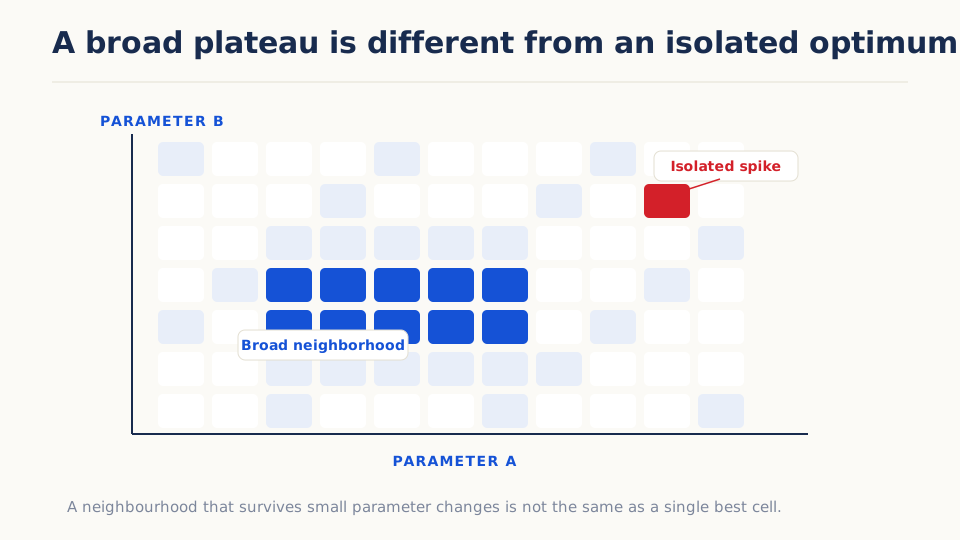
The highest result on the surface is the optimizer’s favorite point under the chosen objective. It is not automatically the most credible strategy. A lone peak surrounded by poor results can reflect sample noise, an event that aligned with one setting, or an unstable interaction between rules.
Sensitivity analysis asks how much the conclusion changes under other reasonable choices. It shifts attention from “which parameter won?” to “what does the research idea look like in a neighborhood?”
Sensitivity, search, and convergence are different questions
| Question | What it examines | What it cannot establish |
|---|---|---|
| Search | Which configurations were evaluated and how were they chosen? | That the tested family contains a durable strategy |
| Sensitivity | How does the conclusion change across nearby inputs and assumptions? | That a smooth region survives later data |
| Convergence | Did the numerical search meet its stopping or stability rule? | That the objective, data, or economic model was valid |
| Generalization | Does a frozen choice retain useful behavior on new evidence? | That the relationship will remain permanent |
A search can converge to a sharp and fragile point. A surface can be smooth because every point shares the same biased data. Generalization must be tested outside the evidence that shaped the surface.
A surface is a map of one objective
If the objective is Sharpe, the surface maps Sharpe. It may hide turnover, drawdown, capacity, trade count, or tail loss. A parameter region can be smooth under gross return and unusable after costs.
Every surface therefore needs:
- the parameter domains and spacing;
- fixed Strategy version and inputs;
- dataset and time window;
- execution and cost assumptions;
- objective direction and definition;
- constraints and failed trials;
- enough secondary metrics to interpret the winner.
Changing the objective changes the landscape. That is a new analysis, not a cosmetic view.
A plateau is usually stronger than a spike
Illustrative example. Suppose a two-parameter search reports:
| Region | Net Sharpe | Turnover | Interpretation |
|---|---|---|---|
| One point at (17, 83) | 1.8 | Very high | Isolated winner |
| Broad area around (20–30, 90–120) | 1.2–1.4 | Moderate | Stable neighborhood |
| Most other settings | 0.2–0.6 | Mixed | Weak parent idea |
The isolated 1.8 may be the numerical winner, but the broad 1.2–1.4 region can be more credible. Its behavior does not depend on one exact setting, and a rounded parameter choice may retain most of the outcome with lower turnover.
This is evidence, not proof. The whole plateau may have been selected from many signal families or may disappear out of sample.
One-dimensional slices can reveal hidden interactions
Heatmaps are helpful but can hide:
- missing or failed trials;
- irregular parameter spacing;
- a third fixed parameter that creates the apparent plateau;
- cliffs near constraints;
- a region supported by very few trades;
- objectives dominated by one time period.
Read marginal slices, trial tables, and outcome distributions. Recompute the surface by subperiod or market where appropriate. A surface stable only because unrelated periods offset each other deserves caution.
Optimizer convergence is a computational statement
An optimizer converges when its search process meets a stopping or stability condition. Depending on the method, that might mean:
- the trial budget was exhausted;
- no improvement occurred for a declared number of trials;
- the model’s acquisition function stopped finding promising regions;
- repeated samples gave similar candidates;
- a numerical tolerance was reached.
Convergence does not mean the strategy is economically valid, the global optimum was found, or the winner will generalize. An optimizer can efficiently converge on a biased objective over leaked data.
Grid, random, and model-based search see the surface differently
A grid covers declared points uniformly but grows rapidly with dimension. Random search samples combinations and often explores high-dimensional spaces more efficiently when only some parameters matter. Bayesian and other model-based methods use completed trials to choose promising next points.
These methods can produce different trial distributions. A model-based search that concentrates around one peak may leave the rest of the surface sparse. Use retained trials and follow-up neighborhoods to understand what was and was not explored.
Sensitivity includes research choices outside the optimizer
Parameter plots do not cover:
- universe definition;
- data vendor or adjustment method;
- start and end dates;
- signal family;
- bar cadence;
- execution fidelity;
- cost model;
- benchmark and objective;
- inclusion of particular crisis periods.
These choices can matter more than the visible parameters. A complete sensitivity review tests the assumptions most capable of changing the conclusion, not only the variables easiest to sweep.
A practical promotion review
- Confirm all trials share the intended data, timing, and cost contract.
- Inspect failures and blocked configurations rather than dropping them.
- Plot the primary objective and important secondary metrics.
- Identify broad regions, cliffs, and isolated peaks.
- Prefer interpretable rounded settings inside a stable region.
- Compare subperiod, market, and walk-forward behavior.
- Evaluate the frozen choice on later data.
- Record the search budget and prior manual choices.
Common optimizer mistakes
- Equating convergence with research validity.
- Promoting the single highest objective.
- Hiding failed trials or zero-trade regions.
- Ignoring turnover and costs on the surface.
- Treating parameter smoothness as proof against overfitting.
- Changing domains after seeing the best region without recording a new search.
- Using a dense plot to imply coverage that the optimizer did not sample.
- Forgetting choices outside the declared parameter set.
Further reading
- Bailey et al., “The Probability of Backtest Overfitting” (2016) — Defines backtest-selection risk in terms of an in-sample winner subsequently ranking poorly on held-out evidence.
- Saltelli et al., Global Sensitivity Analysis: The Primer (2008) — Explains how uncertainty in model inputs and assumptions propagates into outputs and distinguishes local inspection from broader sensitivity analysis.
- Bergstra and Bengio, “Random Search for Hyper-Parameter Optimization” (2012) — Compares grid and random search and explains why random trials can cover influential dimensions more efficiently when only some parameters matter.
- Nocedal and Wright, Numerical Optimization, second edition (2006) — Provides the technical foundations for optimization algorithms, stopping criteria, and convergence; algorithmic convergence does not establish economic validity or generalization.