Later data tests a decision made earlier
A holdout is a portion of data kept out of model selection and parameter choice. It is used after the research decision is fixed to ask whether the chosen process behaves on observations that did not help choose it.
For time series, order matters. Randomly shuffling market rows into training and test sets can let future regimes and overlapping labels leak backward. A chronological holdout preserves the basic research sequence: learn from the past, then evaluate on the future.
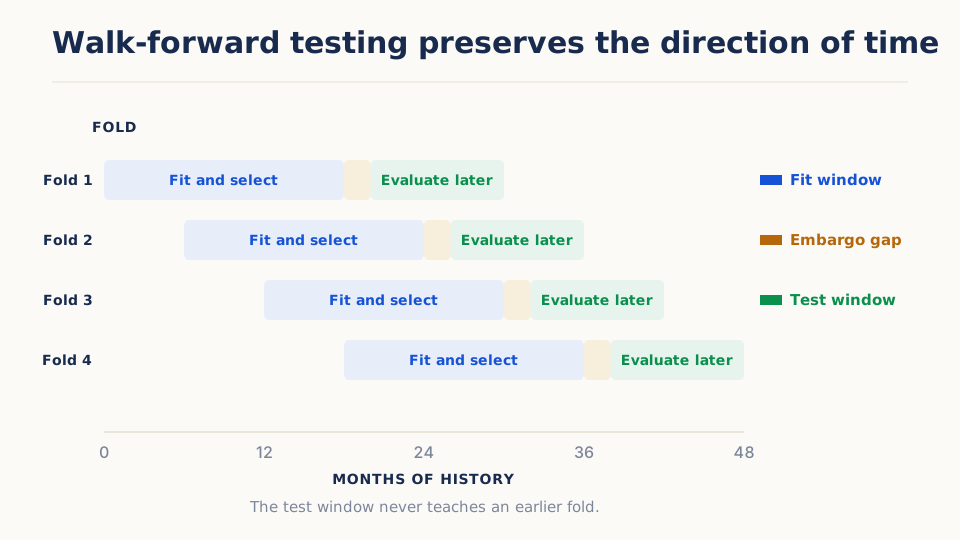
A walk-forward study repeats that sequence through time. It trains or selects on an earlier window, applies the frozen choice to a later window, advances the cutoff, and repeats. The combined out-of-sample segments show how the research process—not one permanent hindsight parameter—would have adapted.
One holdout and walk-forward answer different questions
| Design | What stays fixed | What it helps answer |
|---|---|---|
| Final chronological holdout | One selected design | Did the final decision survive untouched later data? |
| Expanding walk-forward | Training begins at a fixed start and grows | Does accumulating history support stable updates? |
| Rolling walk-forward | Training uses a fixed recent window | Does discarding old regimes improve adaptation? |
| Anchored parameter | Rule fixed across all later folds | Is a durable setting more credible than frequent retuning? |
Walk-forward is not automatically stronger. Repeatedly tuning every fold can create a complex adaptive process with high turnover in parameters. A final holdout is simpler but supplies only one later regime. The research question determines the design.
Development, selection, and final evaluation have different jobs
Not every project needs three literal files, but it does need three logical roles:
| Data role | What the researcher may do with it | What it cannot honestly claim afterward |
|---|---|---|
| Development | Explore definitions, debug rules, and discover plausible ranges | Independent evidence for the design it helped create |
| Selection or validation | Choose among declared alternatives and tune the selection procedure | A final untouched test if its result influenced the choice |
| Final evaluation | Measure the frozen process once on later or otherwise independent observations | Continued freshness after the result is used to redesign the strategy |
With limited history, these roles may be implemented through nested or repeated time-ordered windows rather than one permanent three-way split. The principle is the same: data that changes the rule belongs to the rule’s research history. Renaming a reused period “test” does not restore its independence.
A concrete timeline
Imagine ten years of monthly data:
- Use years 1–4 to define the strategy and choose among declared parameters.
- Freeze the choice and evaluate year 5.
- Expand the training set through year 5, reapply the same selection procedure, and evaluate year 6.
- Repeat until year 10.
Only the evaluation year in each fold belongs to the walk-forward result. Training performance explains the choice but must not be blended into out-of-sample performance.
If the strategy uses a 12-month lookback, each fold also needs warm-up history. That warm-up supplies inputs; it is not an extra evaluation period. If labels or holding periods overlap the boundary, the design may need an embargo or gap so training outcomes do not include events from the test interval.
Freeze the selection procedure, not merely a number
A valid walk-forward design declares before evaluation:
- training and test window lengths;
- expansion or rolling policy;
- parameter search space;
- objective and tie-breaking;
- minimum data and warm-up;
- cost and execution assumptions;
- whether and when re-estimation occurs;
- handling of failed or blocked folds.
Changing the objective after a bad fold uses the test result to redesign the procedure. The next fold is no longer independent evidence unless the redesign is treated as a new research round with a fresh later test.
What to read across folds
Do not look only at the combined return. Inspect:
- how often the selected parameters change;
- whether training winners preserve their rank in the next fold;
- distribution of fold outcomes rather than average alone;
- performance by market state and instrument;
- turnover and costs caused by re-estimation;
- missing, blocked, or low-sample folds;
- concentration in one unusually favorable test segment.
A process that works only when parameters jump dramatically may be exploiting noise or regime labels that are unavailable in real time.
Holdout reuse spends its value
The first look at a holdout is genuinely new evidence. Once its outcome is used to change the strategy, it becomes part of the research history. Repeatedly checking the same “out-of-sample” period until the design passes turns it into another training set.
This does not mean the data must be deleted. It means the claim must be honest: after reuse, another later period or a different independent setting is needed for a fresh test.
Common validation mistakes
- Randomly splitting dependent time-series rows.
- Letting feature computation use the full sample before the split.
- Choosing fold lengths after seeing which design wins.
- Blending training and test returns in one headline.
- Ignoring warm-up and overlapping holding periods at boundaries.
- Dropping failed folds from the summary.
- Retuning on the same holdout while continuing to call it untouched.
- Treating one favorable final period as proof of permanence.
Further reading
- Tashman, “Out-of-Sample Tests of Forecasting Accuracy” (2000) — Examines fixed versus rolling origins, window choices, coefficient recalibration, and multiple test periods. It directly supports designing a chronological evaluation rather than treating “out of sample” as one fixed procedure.
- Bergmeir and Benítez, “On the Use of Cross-Validation for Time Series Predictor Evaluation” (2012) — Compares last-block and cross-validation procedures for time-series predictors and explains how dependence and evolving processes complicate ordinary row-random splits. It provides context for blocked or time-ordered validation.
- Bailey et al., “The Probability of Backtest Overfitting” (2016) — Shows how selection among many investment backtests can defeat the intuition of a simple holdout and introduces a method for estimating that risk. It is a warning about repeated selection, not a universal replacement for walk-forward testing.