Market making means continuously offering to buy and sell
A market maker places a bid below the current market and an offer above it. The bid tells other participants, “I am willing to buy here.” The offer says, “I am willing to sell here.” When one of those orders fills, the market maker has provided liquidity to a trader who wanted immediate execution.
The apparent business is simple: buy at the bid, sell at the offer, and keep the spread between them.
The real strategy is harder because the two fills rarely arrive together. A sell order may hit the bid and leave the market maker long inventory. Price can fall before anyone buys at the offer. Or informed traders may repeatedly select the quote that is about to become stale. Spread capture is compensation for inventory, adverse-selection, and execution risk—not free income for displaying two prices.
A single quote creates four possible outcomes
Illustrative example. Suppose the market is bid 99.99 and offered 100.01. A market maker quotes both sides for one unit.
- Bid fills, then offer fills: buy at 99.99 and sell at 100.01, capturing two cents before fees.
- Offer fills, then bid fills: sell then buy back, also potentially capturing spread.
- Only the bid fills: the maker is long and exposed to a falling market.
- Only the offer fills: the maker is short and exposed to a rising market.
Even in the first two outcomes, price may move adversely between fills, fees and rebates apply, and queue position determines whether either fill was available.
The strategy must therefore manage both quotes and the inventory produced by them.
Why spread compensation exists
Participants who demand immediacy cross the spread. A liquidity provider waits, risks non-fill, and exposes a quote to better-informed flow. The spread helps compensate for:
- order-processing and venue costs;
- holding unwanted inventory;
- the risk that the efficient price moves before inventory is offset; and
- adverse selection from informed or urgent traders.
Two central mechanisms are adverse selection and inventory risk. Informed or urgent flow can make one side of a quote systematically costly, while unwanted inventory exposes the maker to subsequent price movement. These mechanisms can justify compensation in the spread; they do not guarantee that the spread will cover realized losses.
Competition narrows spreads. Volatility, thin depth, and toxic flow can widen the compensation needed. A strategy quoting a fixed spread in every state can be too expensive to fill when conditions are safe and too cheap when conditions are dangerous.
Inventory changes what a fair quote means
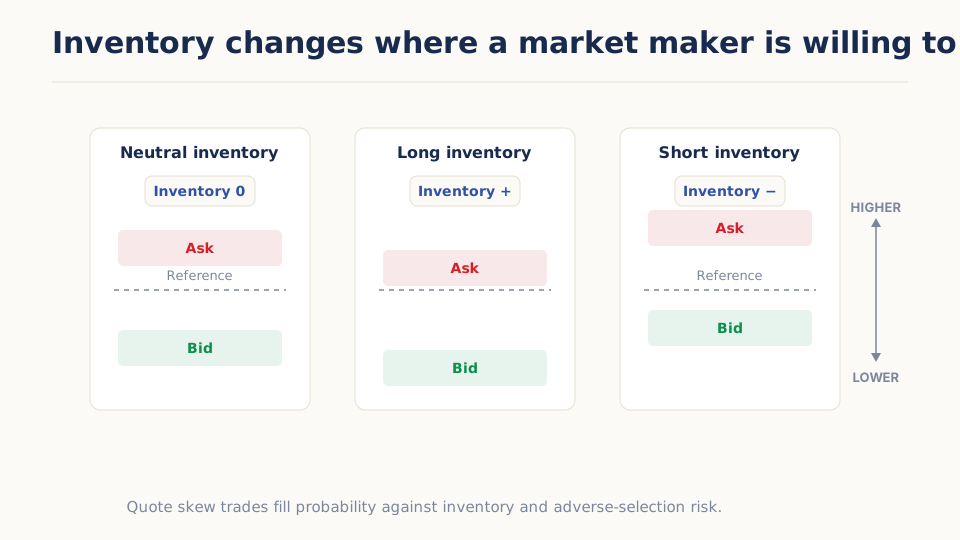
Assume the market maker has accumulated a long position. Another bid fill would increase the unwanted exposure. The quoting policy can respond by:
- lowering both quotes so selling becomes more attractive and buying less so;
- reducing bid size;
- increasing offer size;
- widening the bid;
- actively hedging; or
- stopping new risk at a hard inventory limit.
A reservation price is a model’s inventory-adjusted center. For a long inventory, it is commonly shifted below the neutral reference so the strategy is more willing to sell than buy. It is not an observable true price; it is a control derived from the model’s risk and horizon assumptions.
Toxicity means fills contain bad news for the quote
Flow is toxic when a fill tends to be followed by an adverse price move. If a market maker’s bid fills and the midpoint immediately falls, the captured half spread may be smaller than the markout loss.
Toxicity can increase around information events, fast one-sided flow, or when the maker’s quotes update too slowly. It is measured through declared post-fill price references and horizons, not inferred from a trader’s identity.
A policy may widen, reduce size, or withdraw in toxic states. That can reduce losses and also reduce benign fills, so the filter must be evaluated across all quote opportunities.
The components of a quoting policy
| Component | Choices | Why it matters |
|---|---|---|
| Reference | Midpoint, microprice, model fair value | Centers the quotes |
| Width | Fixed, volatility-aware, inventory-aware, toxicity-aware | Sets compensation and fill probability |
| Inventory skew | Price shift, asymmetric size, hard limit | Controls directional accumulation |
| Quote size | Fixed or state-dependent | Changes risk and queue interaction |
| Refresh | Event, time, or movement threshold | Trades stale-quote risk against lost priority |
| Queue policy | Join, improve, cancel-replace | Determines fill probability |
| Hedge | Same instrument, correlated instrument, none | Changes inventory and basis risk |
| Shutdown | Volatility, loss, inventory, data-quality trigger | Limits operation in unsupported states |
Every cancellation and replacement can lose queue priority. Quoting more frequently is not automatically safer.
An inventory-aware walkthrough
Start with zero inventory and reference midpoint 100.00. An illustrative policy quotes 99.99 bid and 100.01 offer for one unit.
- The bid fills, creating +1 inventory.
- The midpoint falls to 99.99. The policy’s inventory-adjusted center shifts lower and it stops quoting the old bid.
- It posts a smaller bid at 99.97 and a larger offer at 100.00.
- If the offer fills, inventory returns to zero. If another bid fills, inventory rises and the hard limit may prevent further buying.
- P&L is decomposed into spread capture, inventory mark-to-market, fees, hedging, and adverse markouts.
Calling only the completed round trips “market-making trades” would omit the inventory left open during difficult flow. The full state path is the strategy.
Designing a meaningful experiment
Start with a symmetric fixed quote in a controlled replay. Then add one control at a time:
- inventory price skew;
- asymmetric size;
- volatility-aware width;
- toxicity gate; and
- hard inventory and loss limits.
Measure:
- quote time and fill rate on each side;
- gross spread captured;
- fees and rebates;
- post-fill markouts at fixed horizons;
- inventory distribution and maximum inventory;
- inventory P&L versus spread P&L;
- cancellations, replacements, and queue loss;
- adverse behavior during one-sided flow; and
- results after latency sensitivity.
Stress paths where only one side fills, volatility jumps, or the reference moves through several quote levels. A model that evaluates only alternating bid and offer fills has assumed away the central risk.
Why bars cannot certify market making
Market making depends on event order, bid and ask, resting quantity, queue position, partial fills, cancellations, and latency. A one-minute OHLCV bar contains none of that detail.
Quote data can model spread and top-of-book interaction. Depth data can support stronger queue experiments. Even full depth may not reveal hidden liquidity, cross-venue order flow, or the strategy’s true network latency.
Important failure modes
- Adverse markouts exceed captured spread.
- One-sided flow accumulates inventory faster than it can be unwound.
- Stale quotes are selected during information events.
- Cancel-replace loses queue priority and reduces fill quality.
- Fees, rebates, and tick size determine whether the nominal spread is economic.
- A hedge adds basis and execution risk.
- Model fill intensities and toxicity thresholds fail in a new regime.
- A bar backtest invents simultaneous two-sided fills.
This guide remains conceptual with respect to Arizmic. It does not claim that a certified market-making authoring and replay workflow ships in the current product. Depth-fidelity infrastructure is necessary but not sufficient to prove an end-to-end market-making system.
Further reading
- Glosten and Milgrom, “Bid, Ask and Transaction Prices in a Specialist Market” (1985) — Derives an adverse-selection component of the spread when a dealer cannot directly observe whether incoming traders are informed.
- Ho and Stoll, “Optimal Dealer Pricing Under Transactions and Return Uncertainty” (1981) — Develops inventory-sensitive dealer pricing and shows why the two sides of a quote need not remain symmetric after one side fills.
- Panayides, “Affirmative Obligations and Market Making with Inventory” (2007) — Finds inventory-sensitive quote behavior for NYSE specialists when exchange obligations are not binding, while also showing that market rules constrain how theoretical inventory control appears in practice.
- Avellaneda and Stoikov, “High-Frequency Trading in a Limit Order Book” (2008) — Connects reservation price and quote width with inventory, volatility, horizon, and assumed order-arrival intensity. It is a stylized control model, not evidence that its fill process matches a given venue.
- Cartea, Jaimungal, and Penalva, Algorithmic and High-Frequency Trading (2015) — Provides a broader model-based treatment of market making, adverse selection, inventory control, execution, and the assumptions needed to connect those pieces.